zaterdag 1 februari 2020

Feast of the Presentation of the Lord (ABC)


February 2, 2020

Readings:
First Reading: Malachi 3: 1-4
Psalm 24 “Who is the King of glory? It is the Lord!
Second Reading: Hebrew 2: 14-18
Gospel reading according to Luke 2: 22-40

+
Homily: Presentation of the Lord Jesus in the Temple

According to Leviticus 12, a woman who gives birth to a son remains impure for a week, and afterwards immerses in a body of water to purify herself. In rabbinical interpretation of Leviticus 12 any subsequent blood she sees over the next 33 days would be considered dam tohar (דַּם טׂוהַר – ritually clean blood), and that blood does not prohibit her from sexual relations with her husband. The law for a woman who gives birth to a daughter is the same, however, the durations are doubled. The mother becomes impure for 2 weeks, and after immersion, any blood she sees over the next 66 days is dam tohar (https://en.wikipedia.org/wiki/Impurity_after_childbirth). When the days were completed for their purification according to the law of Moses, Joseph and Mary took Jesus up to Jerusalem to present him to the Lord, just as it is written in the law of the Lord, ²Every male that opens the womb shall be consecrated to the Lord . . .² (Luke 2: 22-24).  "Consecrate to me every firstborn male. The first offspring of every womb among the Israelites belongs to me, whether human or animal." (Exodus 13:2, New International Version).  Like the rest of married Jewish women who gave birth to their first born sons, Mary underwent to the purification for 33 days. After her purification, together with Joseph, they brought their son Jesus to the Temple in Jerusalem for his consecration to the Lord and to undergo the ritual of purification for all male Jews, called circumcision, as a lasting covenant between Abraham and God, the Almighty. According to Genesis, God told Abraham to circumcise himself, his household and his slaves as an everlasting covenant in their flesh. Those who were not circumcised were to be 'cut off' from their people (Genesis 17:10-14) (https://www.google.com/search?client=firefoxcircumcision+of+abraham&oq=circumcision+of)

In the Temple, there was a man named Simeon who lived for a long time there. Now there was a man in Jerusalem whose name was Simeon.  This man was righteous and devout, awaiting the consolation of Israel, and the Holy Spirit was upon him (Luke 2: 25).  He lived a religious, righteous and devout life waiting for the coming of the savior of Israel.  The Holy Spirit was with him.  Day in, day out he was at the door of the temple looking every male child brought in thinking that one of these children might be the Messiah of God, the long awaited Savior of the world.  It had been revealed to him by the Holy Spirit that he should not see death before he had seen the Christ of the Lord (Luke 2: 26).  He stayed in the Temple for he was told he will not taste death unless he sees the coming of the Son of God as revealed to him by the Holy Spirit. 

On that day, led by the Holy Spirit, Simeon came at the door of the Temple and saw the coming of the Holy Family.  He came in the Spirit into the temple; and when the parents brought in the child Jesus to perform the custom of the law in regard to him, he took him into his arms and blessed God, saying: . . .  (Luke 2: 27-28).  After performing the prescribed custom of the law Simeon took the child Jesus from his mother’s arms and put him in his breast and said the blessing and a prophesy.  He hallowed God and said the blessing: ²Now, Master, you may let your servant go in peace, according to your word, for my eyes have seen your salvation, which you prepared in sight of all people, a light for revelation to the Gentiles, and glory for your people Israel² (Luke 2: 29-32).  It was fulfilled in him the time the coming of the Messiah.  He saw in his own eyes the child Jesus, the Son of the Living God and of Man, the promised and the prophesy.  So also he said to himself that it is also time to go back to God for he witnessed the fulfillment of the coming redemption of humankind, prepared in sight of all people, a light for revelation to the Gentiles, and glory for your people Israel.

The child parents were amazed of what Simeon told regarding the child Jesus.  The child's father and mother were amazed at what was said about him . . .  (Luke 2: 33); although they knew the future of their son as foretold by the angel of the Lord.  It was confirmed by the old Simeon what was said by the angel to them.  

Simeon continued by adding prophesies with regards to Mary and her child Jesus.  He said to Mary . . . and Simeon blessed them and said to Mary his mother, ²Behold, this child is destined for the fall and rise of many in Israel, and to be a sign that will be contradicted – and you yourself a sword will pierce – so that the thoughts of many hearts may be revealed² (Luke 2: 34-35).  Mary’s heart will be pierced by the sword.  She will also suffer with her son due to division and separation of people with regards to Jesus teachings and preaching, and of his life.  She will undergo the same sufferings of her son on the hands of his enemies.  It is fighting between good and evil.  As in the beginning, in the Book of Genesis, So the Lord God said to the serpent, “Because you have done this . . . And I will put enmity between you and the woman, and between your offspring[a] and hers; he will crush your head, and you will strike his heel” (3:15).

 Another person who stayed in the Temple waiting also for the coming of the Messiah of God, her name was Anna and she was a prophetess, whose father was Phanuel  (Greek: Φανουήλ Phanouēl) or Penuel (Hebrew: פְּנוּאֵלPənū’êl).  He is mentioned once only in the New Testament, in Luke 2:36.  He was a member of the Tribe of Asher and his name means "Face of God". Theologian John Gill supposed that "this man might be a person of some note, or he may be mentioned for the sake of his name, which signifies the face of God, and is the name Jacob gave to a certain place where he had seen God face to face" (Genesis 32:30). As Anna was herself 'very old', it can be assumed that Phanuel was not still alive at the time of Anna's encounter with the child Jesus in the Temple (Luke 2:38). (https://en.wikipedia.org/wiki/Phanuel).  There was also a prophetess, Anna, the daughter of Phanuel, of the tribe of Asher.  She was advanced in years, having lived seven years with her husband after her marriage, and then as a widow until she was eighty-four . . .  (Luke 2: 36-37).  After seven years of marred life, she became a widow and from then on she spent her life in the Temple, serving in the temple and reading/studying the Scriptures for she was guided by the Holy Spirit.  Like Simeon, she also led by the Holy Spirit to meet the long awaited Son of God and Son of Man.  And coming forward at that very time, she gave thanks to God and spoke about the child to all who were waiting the redemption of Jerusalem (Luke 2: 38).  After seeing the child Jesus she gave thanks to the Lord, said the blessing, and made prophesy to those people present, especially to his parents that the redemption of Jerusalem in particular is at hand.

When the purifications of the Mother and the Son were finished, the Holy Family went home in Nazareth, Galilee.  When they had fulfilled all the prescriptions of the law of the Lord, they returned to Galilee, to their own town of Nazareth (Luke 2: 39).  Everything was fulfilled according to the law of the Lord.  Jesus now is truly member of the Jewish community (son of Man) and truly Son of God.  He became under the law of the Lord.   The child grew and became strong, filled with wisdom; and the favor of God was upon him (Luke 2: 40). As the time went by, and under his parents' care and protection, teaching and training about the Law and of God, and their trade, Jesus became wiser, full of knowledge and wisdom, and strong in body and in spirit and the favor of God was upon him.

vrijdag 31 januari 2020

Walters exhibit showcases medieval missal used by St. Francis of Assisi


Walters exhibit showcases medieval missal used by St. Francis of Assisi

 
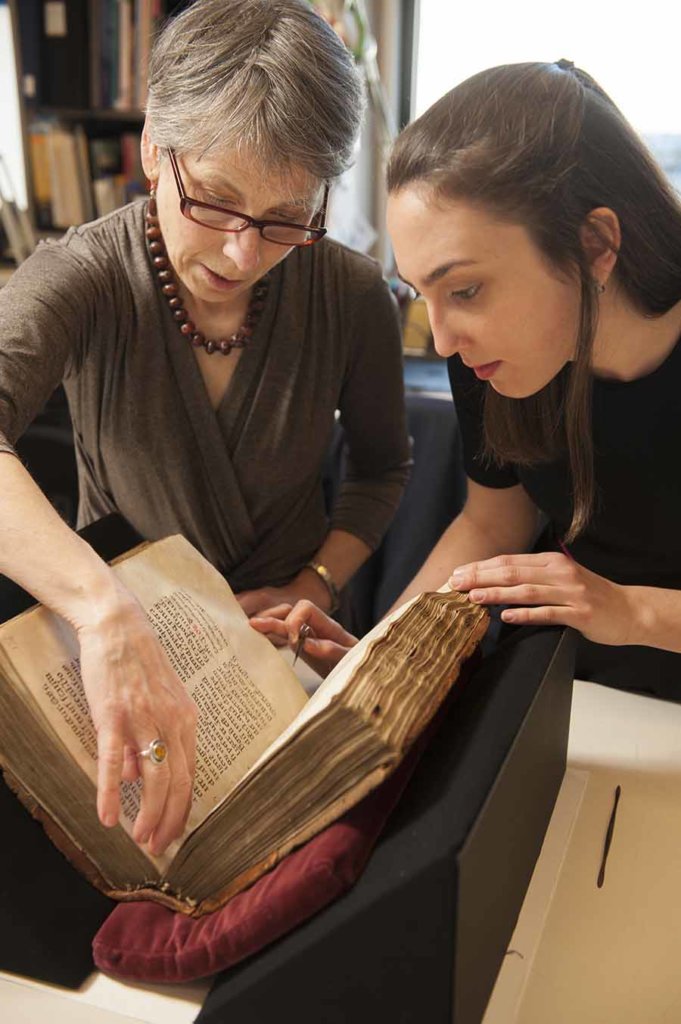
Abigail Quandt, left, head of book and paper conservation at the Walters Art Museum in Baltimore, and Cathie Magee, Andrew W. Mellon Fellow, were part of a major conservation effort that preserved a 12th century manuscript known as the St. Francis Missal. (Courtesy Walters Art Museum)
More than eight centuries ago, St. Francis of Assisi and two companions randomly opened a prayer book three times inside their parish church of St. Nicolò.  Hoping God would send them a message, the wealthy young men prayerfully consulted the manuscript once for each person of the Holy Trinity.  Remarkably, each of the three Gospel passages they landed on contained the exact same command: give up worldly possessions and follow Christ.

Taking the words to heart, St. Francis established a rule of life governing what would become his Order of Friars Minor. The Franciscans embraced radical poverty to draw closer to Christ while also evangelizing others.  The same book that inspired St. Francis in 1208 is expected to inspire thousands of others as the Walters Art Museum in Baltimore places it on public display for the first time in 40 years Feb. 1 through May 31.

The Latin missal, which contains Gospel readings and prayers used at Mass, underwent a painstaking two-year conservation effort aimed at repairing centuries of wear and tear.  The missal, especially beloved by Catholics, isn’t just a historic artifact. Because it was touched by a saint, it is also considered by many to be a religious relic. “This is our most-requested manuscript,” said Lynley Herbert, curator of rare books and manuscripts at the Walters. Herbert noted that Franciscans from around the world have visited the Walters over the decades to catch a glimpse of the richly illuminated book. Because of its significance to the Franciscan community, the Walters has let them view it even when the manuscript’s fragile condition kept it from public display.  “We’ve become a site of pilgrimage,” Herbert explained. “I’m contacted probably monthly, if not weekly, with requests to see this book.”

Herbert said the missal was commissioned for the Church of St. Nicolò in Assisi. An inscription inside the manuscript notes that the book’s donor lived in Assisi in the 1180s and 1190s.
“The manuscript was probably made just before 1200,” she said. “In the 15th century, it had to be rebound because the binding probably started falling apart after so many centuries of use.”  The St. Francis Missal is believed to have been housed at St. Nicolò until an earthquake damaged the church in the 19th century. The church’s artifacts were then dispersed and the church was torn down. All that remains today is the church’s crypt.

Henry Walters, whose art collection became the basis for the Walters Art Museum, purchased the St. Francis Missal from an art dealer in 1924, according to Herbert.

 
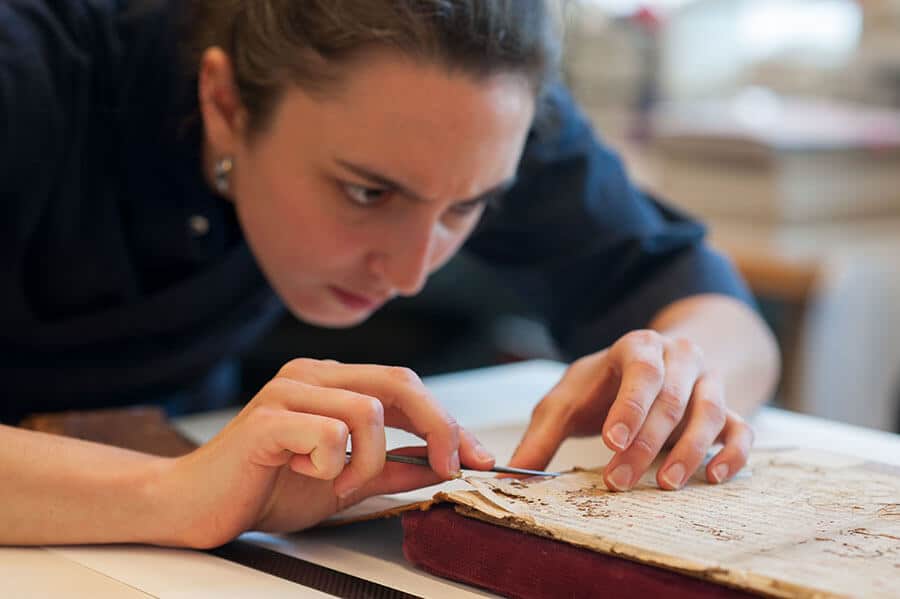
Cathie Magee, Andrew W. Mellon Fellow, works to preserve the St. Francis Missal, a 12th-century manuscript that will be featured in a Feb. 1-May 31 exhibit at the Walters Art Museum in Baltimore. (Courtesy Walters Art Museum)
Abigail Quandt, head of book and paper conservation at the Walters, supervised a meticulous conservation effort undertaken by Cathie Magee, who worked on the project as an Andrew W. Mellon Fellow in Book Conservation.  Quandt said the major challenge was repairing 15th century wooden beech boards that helped hold the book together. The boards and some of the parchment pages had been attacked long ago by insects, she said.  “When they are in the larva stage, they actually work their way through the wood, digesting the starchy components,” Quandt said. “And so this left a lot of holes.”

As the book was continuously used, she said, parts of the boards started to crack and pieces fell off. The sewing also started to break.  Quandt and Magee removed the boards and took the book apart page by page. They filled holes with a special adhesive to strengthen the wood, mended pages and replaced the leather spine with new leather. The entire manuscript was stabilized and stitched back together.  Throughout the preservation effort, Quandt said, conservators used reversible methods so future experts can undo their repairs if needed.

In working on the project, the conservators discovered that unlike what might be expected in such an elaborate manuscript, gold leaf was not used in the St. Francis Missal. The scribes who illuminated the parchment pages instead used silver leaf that was glazed with a type of varnish that made it look like gold.  “That may have been something that was just practiced at that time in that area of Italy,” Quandt said.  Using ultraviolet and infrared lights, the Walters’ team also noticed some mistakes scribes had made in producing the prayer book – missing a word, sentence or even whole paragraphs as they copied sacred texts.  “Typically, the scribe would just take their pen knife and very, very carefully scratch the surface (of the parchment) in order to remove the incorrect letter or word,” Quandt said. “And then they would write over it.”

Seeing those mistakes helps make those who produced the manuscript “more human,” she said.
“It brings them more closer to us,” she said.

 
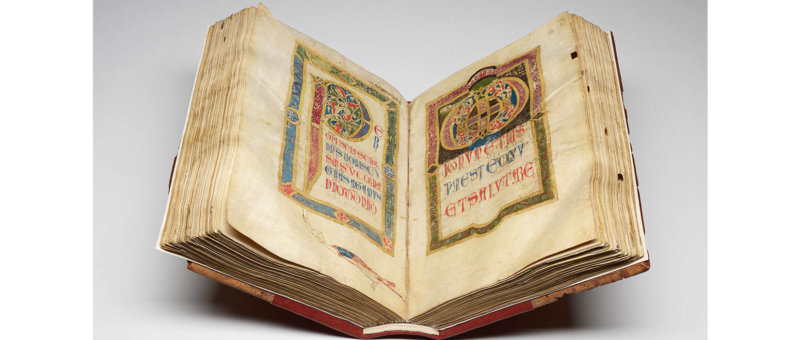
An illumination is shown from the St. Francis Missal that dates to the 12th century. The missal will be on display at the Walters Art Museum in Baltimore Feb. 1 to May 31. (Courtesy Walters Art Museum)
As conservators worked on preserving the manuscript, each page was digitized so anyone with Internet access around the world can view and study the book. It will be available through the Walters’ Ex-Libris webpage.

The upcoming exhibition will also feature several other objects, including paintings, ivories and ceramics of different time periods.  “The cases around the missal will highlight different aspects of the ripple effect of this manuscript across time and how it impacts different people,” Herbert said.
In addition to items related to St. Francis’ contribution to the Franciscan movement, there will be objects connected with St. Clare, the first woman to follow St. Francis, and St. Anthony of Padua, who was focused on preaching and spreading the Franciscan message, Herbert said.  “There’s also a case that will focus on private devotion and secular Franciscans,” she said.

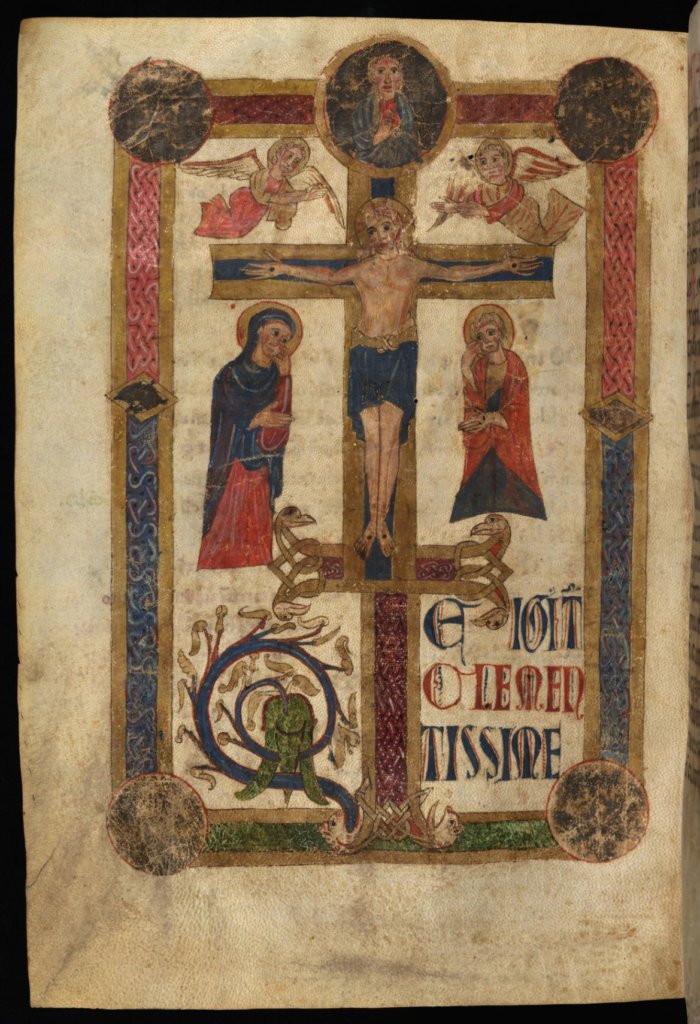
Herbert noted that the missal itself has three full pages of colorful illuminations, including an elaborate depiction of the Crucifixion that shows Christ on the cross with two angels overhead. The Blessed Virgin Mary and St. John the Beloved stand by his side.

The free exhibition, sponsored in part by the Archdiocese of Baltimore, will debut with the book open to one of the three Gospel text passages St. Francis read in 1208. Halfway through the exhibition, the page will be turned to one of the other passages St. Francis read.  “When the manuscript has been shown in the past, it has always been open to one of the illuminations – which are really actually quite lovely,” Herbert said. “But we thought about it long and hard and we decided that it would be more meaningful for people coming to see it for this exhibition if we showed the openings that St. Francis actually may have interacted with.”

zaterdag 25 januari 2020

Third Sunday in Ordinary Time (A)


January 26, 2020

Readings:
First Reading: Isaiah 8: 23 – 9:3
Psalm 27 “The Lord is my light and my salvation.
Second Reading: 1 Corinthians 1: 10-13, 17
Gospel reading according to Matthew 4: 12-23

+
Homily: Calling of the first disciples

Jesus for a while stayed with John in the Jordan after his baptism and before he went in the desert.  He just observed John's living in the wilderness, his food and clothing, his manner of preaching and of baptizing.  When he went away to the desert for forty days and forty nights, he became hungry and thirsty and being tempted by the devil, yet in the end he won all of this.  While he was away, John was arrested by King Herod for being told of his immoral living, and put him in a dungeon. When Jesus heard that John had been arrested, he withdrew to Galilee (Matthew 4: 12).  When Jesus came back from the desert, John was no longer there in the Jordan River. Nobody was there, too.  It was empty.  He learned that John was arrested through the command of Herod.  So, Jesus decided to go back to Galilee, where he lived.

Upon returning to his own town, Nazareth, in Galilee, he decided to move and stay in Capernaum with unknown reason or maybe because he will look there his new disciples or to fulfill the prophesy of Isaiah, the prophet.  He left Nazareth and went to live in Capernaum by the sea, in the region of Zebulun and Naphtali, that what had been said through Isaiah might be fulfilled; 'Land of Zebulun and land of Naphtali, the way to the sea, beyond Jordan, Galilee of the Gentiles, the people who sit in darkness have seen a great light, on those dwelling in the land overshadowed by death light has risen' (Matthew 4: 13-16).  Jesus is the light to the nations and he will bring light to those in darkness and in the shadow of death.  He will bring light, life and hope to the people of Capernaum, land of Zebulun and Naphtali.  They were in darkness and in the shadow of death because no one teaches them the right way of life, to worship the true God and in harmonious relationship with their neighbors, on how to be human. There is a chance to change the way of life now that Jesus came.  They will receive teachings and preaching from the source of light and life.  While there he proclaimed the Gospel news about the Reign-Kingdom of God.  From that time on, Jesus began to preach and say, 'Repent, for the Kingdom of heaven is at hand' (Matthew 4: 17).  He preached repentance for the forgiveness of sins to have a new life in God.

But this ministry of preaching all alone he cannot make it by himself, he needed companions to assist him and to train others in this kind of ministry.  He has to choose and call those he thinks can also carry this same apostolate, that he can trust, simple and humble.  As he was walking by the Sea of Galilee, he saw two brothers, Simon who is called Peter, and his brother Andrew casting a net into the sea; they were fishermen (Matthew 4: 18).  Before he came to Capernaum, he already met Andrew and John, former disciples of John the Baptist who said and pointed Jesus as the Lamb of God and they followed him.  Andrew was the one who brought his brother Simon to Jesus who he called Peter; while John (the beloved) introduced James to Jesus as well.   

First, Jesus came to the boat of Peter and Andrew who were casting their nets at that time.  They were fishermen.  He said to them, 'Come after me, and I will make you fishers of men' (Matthew 4: 19).  He called them to become his disciples and fishers of men (catching men and women).  At once they left their nets and followed him (Matthew 4: 20).  Their responses were leaving their boat and nets, their livelihood and family and followed Jesus wherever he might go.

Together with Peter and Andrew, Jesus continued his walking and searching.  He walked along from there and saw two other brothers, James, the son of Zebedee, and his brother John.  They were in a boat, with their father Zebedee, mending their nets (Matthew 4: 21).  He found James and John, sons of Zebedee, in a boat with their father mending their nets.  He called them, and immediately they left their boat and their father and followed him (Matthew 4: 22).  He also called them to become his disciples who will help him in proclaiming the Kingdom of God to all people they caught. They responded immediately when they also saw Peter and Andrew following Jesus.  They left their father in the boat and followed Jesus as well.  In just one day, Jesus found true disciples who can also do what he does, spreading the good news of the Kingdom of God through repentance from sinful life.   He went around all of Galilee, teaching in their synagogues, proclaiming the Gospel of the Kingdom, and curing every disease and illness among the people (Matthew 4: 23).  Jesus roamed around in Capernaum, with his first four disciples, teaching and proclaiming the Kingdom of God with curing every kind of diseases, illnesses and driving out demons in their synagogues.

zaterdag 18 januari 2020

Second Sunday in Ordinary Time (A)


January 19, 2020

Readings:
First Reading: Isaiah 49: 3, 5-6
Psalm 40 “Here am I, Lord, I come to do our will.
Second Reading: 1 Corinthians 1: 1-3
Gospel reading according to John 1: 29-34

+
Homily: The Lamb of God

John the Baptist was much aware of the coming of the Messiah.  He was waiting and expecting his coming very soon.  He was very excited too to that coming event.  John the Baptist saw Jesus coming toward him and said, 'Behold the Lamb of God, who takes away the sin of the world.'  He is the one of whom I said, 'A man is coming after me who ranks ahead of me because he has existed before me’ (John 1: 29-30).  When Jesus was coming to John, he easily recognized him.  He called him the Lamb of God.  This theme or motif, Lamb of God, is also popular in the ancient world of Israel (in the Old Testament), similar to the Paschal Lamb.  For centuries people worshiped God by sacrificing animals. They killed them and offered them to God. For the Jews a lamb was the main animal of sacrifice. In the Temple a lamb was offered every day. The sacrifice of a lamb also played an important part in the Exodus.  God led the Israelites out of Egypt, where they were slaves, and into the Promised Land.  On the night God's people were to depart, the firstborn in all the Egyptian families died.  The firstborn of the Israelites were saved because God had instructed them to kill a lamb or goat and mark their doorposts with its blood.  The angel of death then knew to pass over those houses.  The Israelites ate the lamb in a meal before they left. The lamb was to have no blemish, and none of its bones were to be broken (https://www.loyolapress.com/our-catholic-faith/scripture-and-tradition/jesus-and-the-new-testament/who-do-you-say-that-i-am-names-for-jesus/jesus-the-lamb-of-god).  Jesus is that lamb who takes to himself the sins of the world.  Jesus chooses to suffer crucifixion at Calvary as a sign of his full obedience to the will of his divine Father, as Son of God in carrying away the sins of the world (https://en.wikipedia.org/wiki/Lamb_of_God) by his death on the Cross.  He is the lamb that was slaughtered and offered in the altar of the Lord God in replacing us for the forgiveness of our sins.   

John continued in saying after him in his ministry, another one is coming to continue what he had started and that was Jesus; he came ahead of him because he existed before him.  Before the world and all in it was created and or began, Jesus was already present and existed.  He is already here and there.  He existed with God the Father and the Holy Spirit.  It was also included in the plan of God that the Son of God will become part of all created beings and to be the Son of Man, through Mary, and do the will of God his Father..   

John was right when he said that he did not know that his cousin Jesus was the long-awaited Messiah, the anointed one.  He did not expect that Jesus, who is son of Mary and Joseph, was the Son of the living God.   I did not know him, but the reason why I came baptizing with water was that he might be made known to Israel (John 1: 31). Although he used the rite of baptism, the baptism of cleansing and repentance of all sins done, which is not applicable to Jesus, it was by this baptism that he whom he expected to come will appear, it became a means to employ so that Jesus may revealed himself when the time comes.  John introduced Jesus to the people of Israel through his testimony, and baptism of water. 

To prove what he said, he also testified about Jesus as the Lamb of God and the Son of God.  John testified further, saying, 'I saw the Spirit come down like a dove from the sky and remain upon him' (John 1: 32).  He attested and affirmed that he saw the Holy Spirit came down from heaven and rested above his head.  He saw the heavens opened and the Holy Spirit in a form of a dove descending from the sky and remains in him.  And again he repeated the unknowing of him about the coming Messiah, Jesus.  I did not know him, but the one who sent me to baptize with water told me, 'On whomever you see the Spirit come down and remain, he is the one who will baptize with the Holy Spirit' (John 1: 33).  He was telling the people about his sending, role and mission.  He was told by the voice of God the indication in knowing he who is to come, the Holy Spirit will come to a man after he was baptized and descended and remain in him from then on.  If he baptized water, the one who is to come will baptize with the same Holy Spirit and fire.  Now I have seen and testified that he is the Son of God (John 1: 29-34).  He manifested and confirmed right there and then that Jesus the Lamb of God is truly the Son of God.