VATICAN CITY, OCTOBER 2, 2018 (Zenit.org).- In this
exclusive interview with ZENIT, Father Jaime Castillo Villacres, Rector
of the Seminary of Loja, in Ecuador, answers key questions on vocational
discernment and the formation of seminarians, in face of the challenge
to renew the “Formative Project” in the light of the new
Ratio Fundamentalis Institutionis Sacerdotalis.
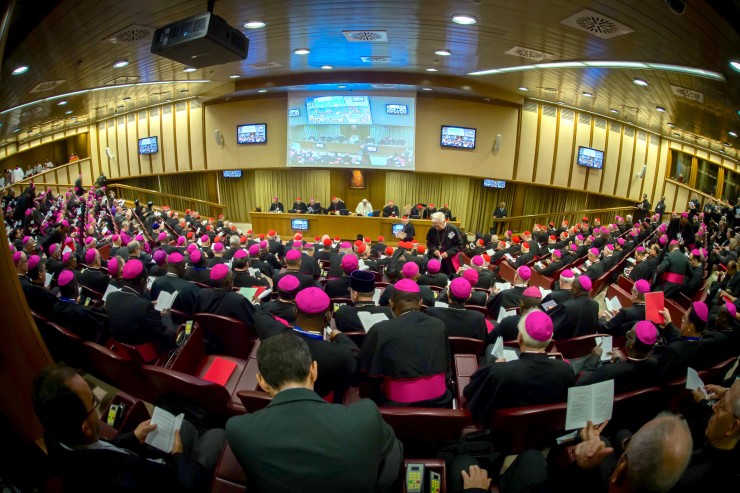
This reflection is understood in the framework of the ongoing Synod
of Bishops on “Young People, the Faith, and Discernment,” being held
from October 3-28 in the Vatican, and in the wake of the recent events
in the heart of the Church (the resignation offered by all the Bishops
of Chile, the Pope’s suspension from all functions of former Cardinal
McCarrick, the removal of Karadima from the clerical state, and the
publication of the Pennsylvania Report on sexual abuse).

Father
Jaime Oswaldo Castillo Villacres was born on September 17, 1973. He has
dedicated a good part of his 20 years as a priest to the formation of
young people (youth pastoral work and vocational formation). He has
collaborated as formator and professor of Dogmatic Theology in two
seminaries for seven years: the
Reina del Cisne Seminary of Loja and the
Jesus Good Shepherd Seminary of Riobamba, in Ecuador.
Father Villacres is beginning his second year as Rector of the
Reina del Cisne
Major Seminary of Loja and has, together with the formative community,
the “challenge” to renew the “Formative Project” offered by the new
Ratio Fundamentalis Institutionis Sacerdotalis.
Here is a translation of Father Jaime Castillo Villacres’ exclusive interview with ZENIT.
* * *
ZENIT: What human, spiritual and intellectual requirements does a candidate to the priesthood need?
Father Castillo: The priesthood,
gift that God puts in the heart of some men, calls, from the one who
feels this divine call, for a very generous answer. In the educational
process, the candidate assumes progressively the essential traits of
Jesus, the Good Shepherd: he looks after, nourishes and corrects the
flock (Jn 3:15). Given this vocational challenge, the human, spiritual
and intellectual requirements are indispensable and inseparable
conditions. Human maturity is necessary, which entails adequate physical
and psychic health. When a youth enters the seminary, he brings with
him his vital world, which he has experienced in his family and
socio-cultural environment. I remember my first formator who said to me:
“the candidate to the priesthood doesn’t fall from heaven.” He was very
right. We arrived with cultural, religious and spiritual diversity.
Today those young men enter our processes of vocational discernment who
God has enabled to respond. We adults — fathers of families, professors,
educators, and formators, should have enough creativity and docility to
understand the new cultural paradigms of young people.
ZENIT: Do you think that it’s more appropriate to give more importance to intellectual capacities than to emotional balance?
Father Castillo: The new directives for priestly formation, which are harmoniously well oriented in the new
Ratio Fundamentalis,
enable us to understand that formation to the ordained ministry is
characterized by gradualness and completeness. That is, the educational
processes in the seminary take care of the totality of the person in his
different dimensions: human, spiritual, intellectual and pastoral. It’s
very necessary to constitute a stable personality, to cultivate ideal
qualities in young men that enable them to assume the gift of the
vocation to the presbyterate (RF, 94), because “the lack of a
well-structured and balanced personality becomes a serious and objective
impediment for the continuity of formation to the priesthood” (RF, 63).

Since Pope Francis proposed to the whole Church — through
Evangelii Gaudium — the
category of discipleship as the fruit of the reflection in Aparecida,
we realize that the most important thing in the priestly vocation is the
journey of discipleship. The seminarian must undertake a journey of
discipleship, which is prolonged for the whole of his life. In this
journey, the cultivation of the intelligence is also necessary. I
believe that a well-cultivated mind makes it possible to open new
horizons for a humanizing commitment in the Church. One must facilitate
in a future priest a fruitful meeting between human values and
intellectual preparation so that he’ll be a valid interlocutor in a
plural and heterodox world. There comes to mind right now an instructive
and thought-provoking phrase of Sister Andrea Tacchi, on referring to
Pope Francis, which clarifies this anxiety much better:
“Combined admirably in Francis is the intelligence of a Jesuit and
the humility of a Franciscan. If one is only intelligent, one can be
proud; if, in addition, one is humble, one triumphs!”
ZENIT: What consequences can it have in the candidate himself and in the people to whom he will be dedicated?
Father Castillo: Well, if there
isn’t emotional balance and the minimum necessary to relate to persons
normally, the consequences are very serious. By the way, let it be said:
the priest is a man of relationship. Therefore, without human maturity,
the individual experiences withdrawal into himself to the detriment of
the community. The Church has the right to exact that her ministers are
able to serve the Christian community evangelically and this entails
tested human maturity. Let us remember that faith can grow, mature, and
bear fruits in an integrated, not divided, human being, in a heart
unified by the cause of the Kingdom and its justice.
ZENIT: Pope Francis recently exhorted a group of Bishops in
the Vatican to give priority to vocational discernment “to help young
people recognize the voice of God among the many that resound in the
ears and in the heart.” How must a rector or spiritual director guide a
youth, in the journey of discernment, who feels called to the
priesthood?
Father Castillo: This question is
very valuable because it leads me to speak about the importance of the
formation team. As is known, the bishop is the first one responsible for
priestly formation. However, the bishop delegates responsibility to the
rector and to the formators, in the framework of subsidiarity. The
formators, disciples of the Lord, are the presence of the Father and
pastor (bishop) in the seminary because they have received his trust to
channel the processes of discernment, helped by the light of the Holy
Spirit. To this end, it’s a priority to assume the experience of
ecclesial mediation. To what am I referring? One doesn’t walk alone in
the Church. One needs a companion on the way. Our walking is synodal.
One needs human mediations. In the end, the call to the priesthood is
made palpable through brothers and sisters in a particular community
context. As Benedict XVI said: “one who believes is never alone.” The
one who speaks in an irreplaceable way is the Spirit in each one’s
conscience, in that sense God inspires what we must do and say. However,
this same God makes use and needs human instruments that accompany the
path of decisions through contrasts to persons’ aspirations, often very
subjective.

Keeping
in mind what we have said, the voice of the spiritual director and of
the rector (in their different competencies and levels of communication)
is more than necessary. The voice of the spiritual director exists to
understand through mercy the seminarian’s vocational answer; to contrast
the candidate’s possible subjectivisms, review the plan of life
(personal history, progress or setbacks in the seminarian’s different
stages); verify the authenticity of the call (personal conversations
and biweekly meetings). Likewise, the rector has the delicate mission to
take care and to foster a healthy environment for formation. He must be
able to make opportune inquiries and questions to verify the conscious
answer of the candidate to the priesthood. He must also validate,
periodically, the continuity of the process of formation of each
seminarian, helped by the advice of the formator Fathers and the
specialists in human sciences, especially clinical psychology.
ZENIT: What determines the differences between a diocesan
seminary and another of some order or movement (for instance, the
missionary Seminaries of the Neo-Catechumenal Way or the Schoenstatt
Seminaries) in regard to norms and periods of formation?
Father Castillo: Each religious
community, diocese or ecclesiastical jurisdiction has a very particular
history, which must be known to avoid anachronistic prejudices and
approaches. There are dioceses that have good formation teams and
adequate physical areas to set out an educational project in the
seminaries, and this strength must be promoted. There are others that
have experienced a strong diminution of vocations, but they don’t cease
to promote this legitimate area of ministry in the Church. And this need
leads them to look for other places to form their presbytery. I must
articulate some specifications about this:
- If a bishop decides to entrust to a center of ecclesiastical
studies, seminary or movement the formation of his seminarians, it will
be because he can’t guarantee priestly formation in his diocese. There
are already valuable experiences that exist of national and
inter-diocesan (regional) initiatives, as the fruit of the communion and
communication of goods in the Episcopal Conferences. But it is prudent
that the diocese of origin offer serious vocational accompaniment so
that the seminarians remain rooted in the cultural and religious
reality, where they will exercise their future pastoral ministry.
- If there is a case where a bishop entrusts the formation of a part
or totality of his seminarians to some apostolic movement, the
responsibility in terms of ecclesial communion is of greater commitment
for the latter. The spirituality of the diocesan priest stems from his
ministry; he is called to configure himself to Jesus the Good Shepherd
and to be a servant of all the holy people of God. He has the challenge
of being a man of communion who receives all and is at the service of
all. The community or movement in charge of the formation must be able
to relativize its charism in keeping with ecclesial communion. And it
would be of much help to him to beware of those conceptual dichotomies: a
hierarchic, charismatic, lay Church? Let us say it very forcefully: the
Church is ministerial. There is a ministerial dynamic where the Church,
community of communities, is the large house where we all find our
space.
- Particularly interesting is the contribution of the Ratio Fundamentalis, which
establishes norms, regulations, stages, processes and times for the
whole process of priestly formation. I recommend that it be read,
meditated upon and studied, because there is a new paradigm there for
the priest of our time. And also the Ratio Fundamntalis of each
nation, as the fruit of the agreements of the Episcopal Conference,
which enables the reception of the universal proposal and the assumption
of one’s reality in the formative field.
ZENIT: The new Ratio Fundamentalis Institutionis Sacerdotalis, issued in 2016 by the Congregation for the Clergy, states very clearly: “In regard to persons with homosexual tendencies that
approach the Seminaries, or that discover this situation during the
formation, in coherence with the Magisterium, the Church, profoundly
respecting the persons in question, cannot admit to the Seminary and to
Holy Orders those that practice homosexuality, present profoundly rooted
homosexual tendencies or uphold the so-called gay culture.” Therefore, if it’s detected that a seminarian is homosexual, should one proceed to expel him from the Seminary?
Father Castillo: The Seminary’s
mission is to help to identify, in so far as possible, the vocation of
each of the young seminarians, and especially to confirm the conscious
option for commitment in the ministry to the presbyterate. On more than
one occasion I have had the opportunity to help to reorient the
vocational option of a candidate to the priesthood, while other
intentions persisted that were not in accord with the specific mission
that the Church would entrust to him. In the case of homosexuality, as
the Church poses it to us at present, it is incompatible, because of its
nature, with the priestly ministry. If admitted to the priesthood,
perceived sooner or later would be the truth of his life in his sexual
conduct. I would recommend the same for a heterosexual seminarian
(separation from the seminary), who is unable to understand and to
assume the gift of chastity and of celibacy. Moreover, I would take the
opportunity to have him understand that
it would be gravely
dishonest of the candidate to conceal his homosexuality, to access
ordination despite everything. This disposition is lacking in rectitude
and does not correspond to the spirit of truth, of loyalty and of the
willingness that must characterize the personality of one who believes
he has been called to serve Christ and his Church in the priestly
ministry” (Cf. Instruction of the Congregation for Catholic
Education on the criteria of vocational discernment in relation to
persons of homosexual tendencies before their admission to the Seminary
or to Holy Orders, n. 3).
ZENIT: What might be the appropriate place in the Catholic Church for an ex homosexual seminarian?
Father Castillo: My attention is much called and I try every day to live a beautiful intuition of Saint Euphrasia. She said: “
A life is worth more than the whole world.” The
Catholic Church as Mother and Teacher, but especially as the Lord’s
disciple and, as such, and in so far as possible, must seek the good of
persons. The Church is the house of all. By separating a homosexual or
heterosexual seminarian from the process of discernment, doesn’t exclude
him from ecclesial communion, but helps him to think responsibly of his
vocational situation. The appropriate place that corresponds to him is
like that of all: to set out on the path of discipleship of Jesus and to
follow Him to receive the novelty of his Word and the evident demands
of His love.
ZENIT: What measures must a bishop or superior apply to a
priest if it’s discovered that he is homosexual? Is it appropriate to
suspend him from the priesthood?
Father Castillo: In this respect, a
bishop or superior who accompanies his seminarians — within his
possibilities and after the scrutiny carried out by the formators in the
Seminary and the proclamations before the faithful people –, has the
moral certainty of the suitability of the candidate, to confer the
Sacrament of Holy Orders. However, in this journey of love and risk, he
can also meet with this human reality.

I think that the situation of the priest should be evaluated
thoroughly, to stir effective sincerity about his personal life, assess
the degree of incidence of his behavior not only in the community, but
in the presbytery and in his perception of individual awareness. If the
priest’s behavior is scandalous and puts in danger the moral values of
the Christian community, it would be appropriate to call his attention
to it seriously, to offer him spiritual support and assess his behaviour
over time, without neglecting psychological assessment and support.
In case of relapse, where the inability to live his priestly
promises, as a disciple of Christ, is notorious, it would be advisable
for him to rethink his vocational option, as in the case of a
heterosexual priest when he is conscious of his failures and
inconsistencies in his life surrendered to God. He should be invited to
opt for a path of conversion and purification, of profound trust in
God, having chastity as a great value.
ZENIT: Do you see as feasible the possibility that one day
the Catholic Church will admit the option of marriage for priests,
despite maintaining the option of celibacy, and in addition to the
already existing exceptional cases with priests of the Eastern Rite
(the Greek- Catholic Church of Ukraine, the Egyptian Copts and the
Lebanese Maronites), widowers, and the priests that come into the
Catholic Church from the Anglican or Episcopalian Confession?
Father Castillo: In this argument, one must proceed always with the prudence of the
sentire cum eclesiae.
Today the Church asks for priestly celibacy because she knows it’s a
gift of God, and a good for pastoral fruitfulness. I’m conscious that
the Church isn’t born with me, but that I am part of her. I am within a
great chain of witnesses of the faith. Thanks to the Church, I have
received the gift of faith and of the priesthood in this stage of
history, blessed and loved by God. In my 20 years of priesthood, I have
been able to value the wisdom of the Church in asking me to live the
consecration to God in a dynamic of celibacy. It’s a gift and a task. I
ask the Lord every day: “Grant me the grace of celibacy.” It’s a grace
of the Lord to renew each day the “yes” that commits my whole existence.
The priestly vocation is a call that looks to totality; partial
answers annihilate the renewing strength of love. And the moments of my
inconsistencies and anti-vocational attitudes have helped me to
understand that God dwells in all that is authentically human. Celibacy
is a gift of God for his Church and we must promote and love it; it
gives us an inner freedom that enables us to serve all without excluding
anyone.
In regard to the possibility that at some time the Church might opt
for married priests, I recommend not giving space to propagandist
predictions but to leave room for the path of the Spirit in His history
of salvation. If this step is taken it will be an option that the Church
discerns and will be undoubtedly suggested by the Holy Spirit, because
He acts in history and always in favor of the human being. Let us recall
that, as an instrument of salvation for the whole human race, the
Church is “auditor” of the Spirit’s voice. He himself will lead her to
the full truth. (
John 16:13).
ZENIT: The Synod of Bishops will be held over the next few days on Young People, the Faith and Vocational Discernment. From your experience, what challenges do the pastors of the 21st century have in accompanying young people and, concretely, the seminarians?
Father Castillo: Challenges for pastors and faithful of the one people of God:
- to look for creativity in our pastoral areas to listen to young
people with parrhesia and without subterfuge. The Gospel illumines and
transforms the cultural reality of our young people.
- To welcome the style of the Successor of Peter, Pope Bergoglio who
wishes to build a synodal Church. To support the process of reform of
the Church, which consists essentially in conversion to the Gospel.
- We, Jesus’ disciples of the 21st century, must live in fraternity, mercy and in permanent listening to the Gospel.
- We, Pastors, must reject any type of clericalism that fosters an
anti-evangelical mentality, which is spelled out in any abuse of power,
of conscience and sexual abuses.
- We must discover that there is much good, truth and beauty in people’s heart.
- The renewal of the whole Church depends also on the disciple who is a priest.
– To learn from Mary, Mother of the Church, docility to the Spirit
and, from her divine maternity, the audacity of her tenderness.